
Visa Introduces Stablecoin Platform
Weekly Market Update #119


This week’s edition is brought to you by TenX Protocols Inc., a multi-asset digital treasury for Solana, Sui, and Sei, where Networks Become Revenue.

Before jumping into last week’s action, check out the following pieces:
The DEFT Valour Investment Opportunity Index (DVIO), engineered by DeFi Technologies, tracks the top 50 crypto assets by AUM across Valour’s 100+ exchange-listed ETPs. Every constituent represents real, regulated investor capital, with weights rebalanced weekly to reflect shifts in capital allocation and net flows. Proprietary research on the index is published weekly here.
Weekly Market Developments
Jito’s JIP-38 passes, directing about 80% of the fees from its new JTX trading platform to JTO buybacks and burns for at least a year - link
Jupiter launches Jupiter Gacha in beta, an onchain gacha for tokenized, physically backed graded Pokemon and One Piece trading cards - link
Former Ethereum Foundation privacy researchers launch EthSystems, an independent company building confidentiality infrastructure for institutional Ethereum - link
Plasma brings its Plasma One stablecoin banking app to Android through Google Play, extending the neobank beyond iOS - link
Visa introduces the Visa Stablecoin Platform, a beta service letting banks and fintechs mint, move and manage stablecoins across a network that reaches more than 200 million merchants - link
JPMorgan, BlackRock and Goldman Sachs are among more than two dozen firms in DTCC’s first live production trades of tokenized stocks, ETFs and Treasurys, with a full launch targeted for October - link
Japan’s Diet passes a bill reclassifying crypto as a financial product under its securities law, a step toward spot crypto ETFs and a future flat 20% tax - link
Strategy raises $466.7M through its common-stock at-the-market program and buys no bitcoin, holding steady at 843,775 BTC - link
Uniswap governance passes a temperature-check vote to extend its protocol fee and UNI burn to Robinhood Chain, with a binding on-chain vote to follow - link
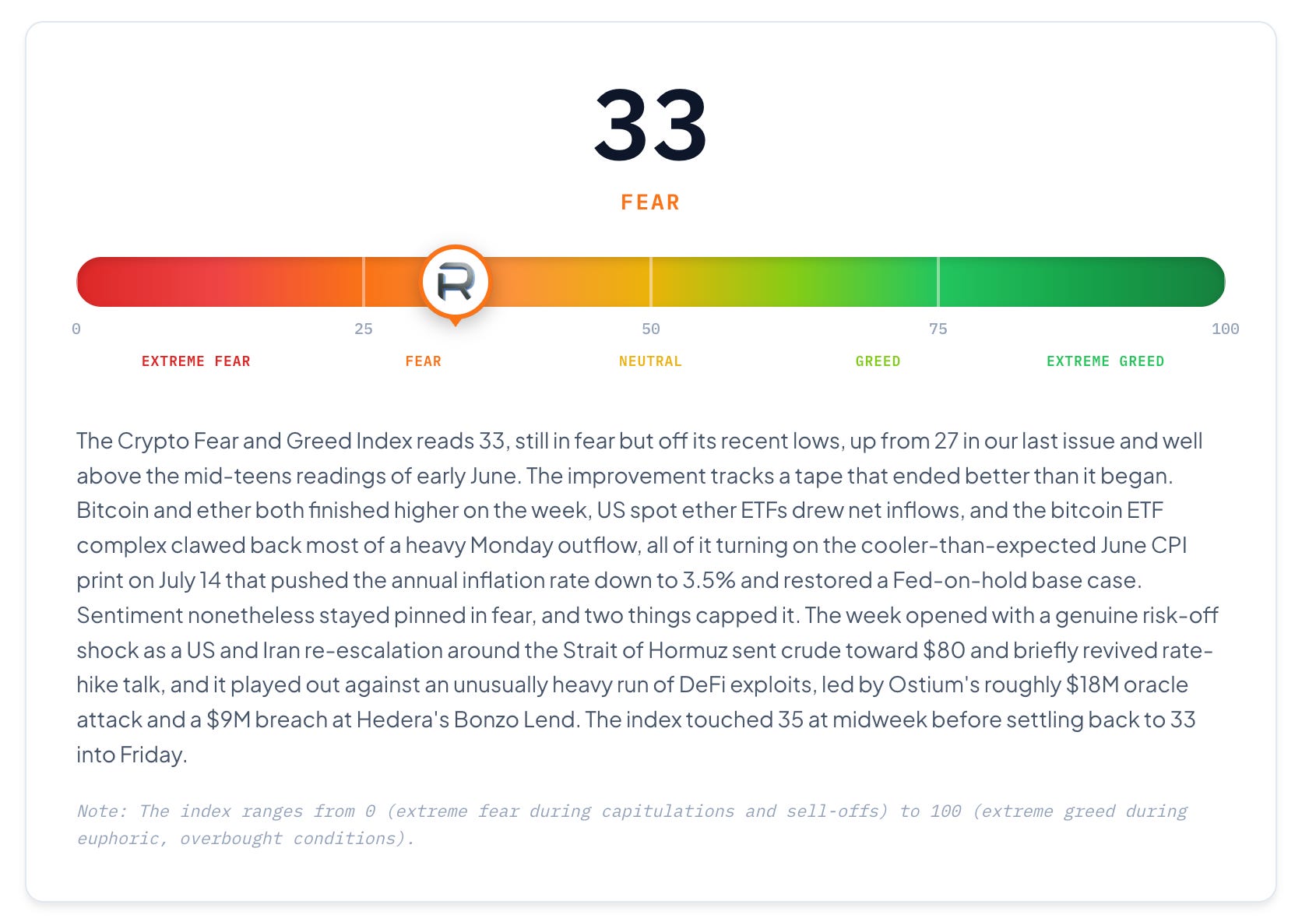
Fear & Greed Index
ETF Flows
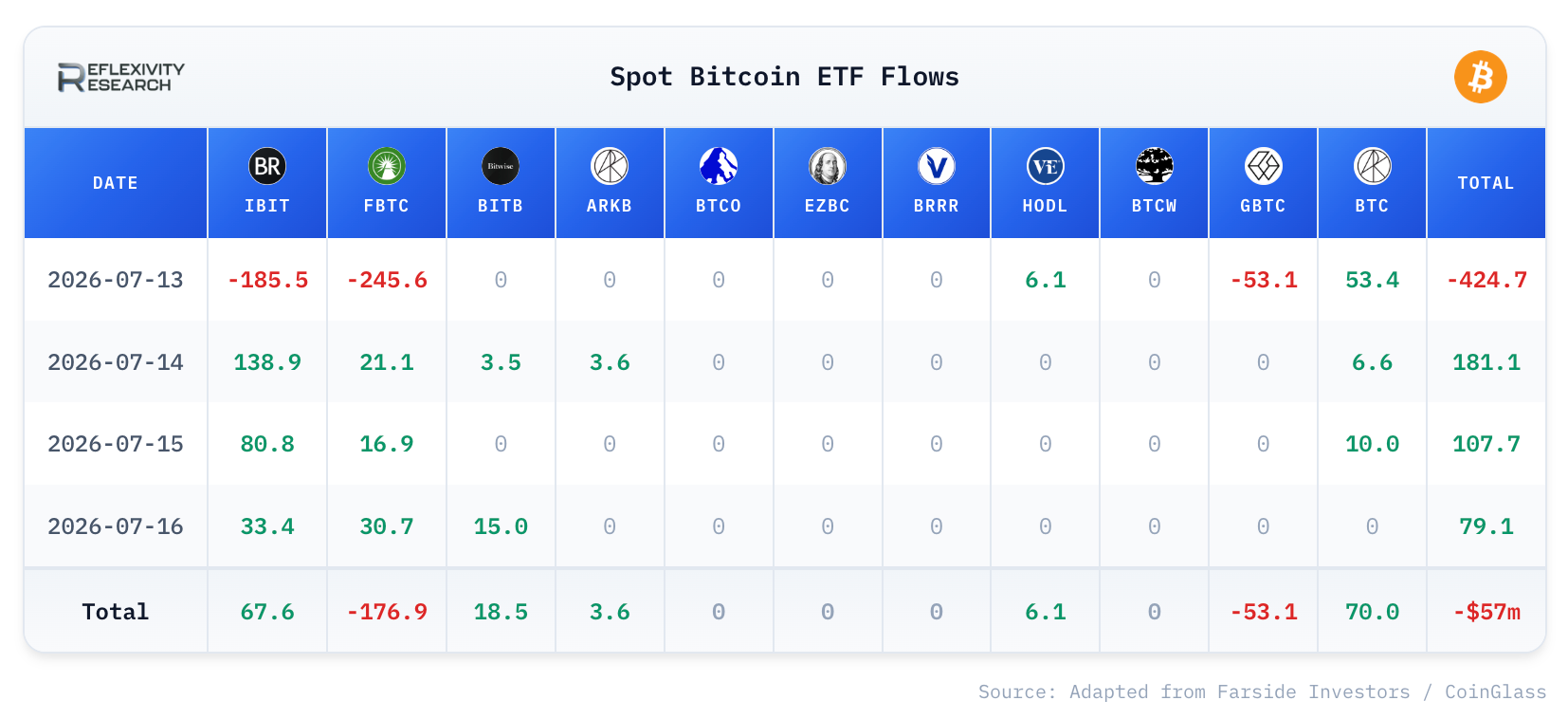
US spot Bitcoin ETFs closed the four sessions of July 13 to 16 a net -$56.8M, a fractionally negative week that hides a sharp mid-week turn. Almost all of the damage came on Monday July 13, when the complex shed -$424.7M in a single session. The trigger was macro rather than idiosyncratic: a weekend re-escalation of US and Iran tensions around the Strait of Hormuz sent crude sharply higher, with WTI moving from around $72 toward $80, and briefly revived speculation that the Federal Reserve's next move could be a hike rather than a hold, pushing institutions to de-risk ahead of a data-heavy week. Fidelity's FBTC led the exits at -$245.6M and BlackRock's IBIT gave up -$185.5M, but no fund-specific catalyst was identified; this was broad caution, not panic. Bitcoin itself slipped to about $62,400 on the day.
The pivot arrived at 8:30am ET on Tuesday July 14, when the Bureau of Labor Statistics reported that June CPI fell 0.4% on the month, its largest one-month decline since April 2020, taking the annual rate to 3.5% from May's 4.2% and below the 3.8% consensus. Core CPI was flat on the month at 0.0% and eased to 2.6% year over year, also under estimates, with a 5.7% drop in energy prices doing much of the work. The print was cooler than expected on every line. The rate-hike odds that had spiked on the oil move unwound, restoring a Fed-on-hold base case rather than a rate-cut trade. Bitcoin rallied about 4% back above $64,000, and the ETF complex flipped to three straight inflow days: +$181.1M on July 14, +$107.7M on July 15 and +$79.1M on July 16, +$367.9M in all. It was not quite enough to fill Monday's hole, leaving the week just short of flat, but the price told the cleaner story: BTC peaked just above $65,000 intraday on Wednesday and held in the mid-$64,000s into Thursday, finishing up on the week even as flows netted red.
The week's most telling disclosure sat alongside the flows. In an 8-K filed Monday July 13, Strategy reported raising $466.7M through its common-stock at-the-market program during the July 6 to 12 week and buying no bitcoin, leaving its holdings unchanged at 843,775 BTC. For the market's most visible structural buyer to raise equity and add nothing to its stack, on the same session the ETF complex shed $424.7M, underscored how fragile the institutional bid had become before the CPI print rescued the tape. The next FOMC meeting lands July 28 to 29, after this issue.
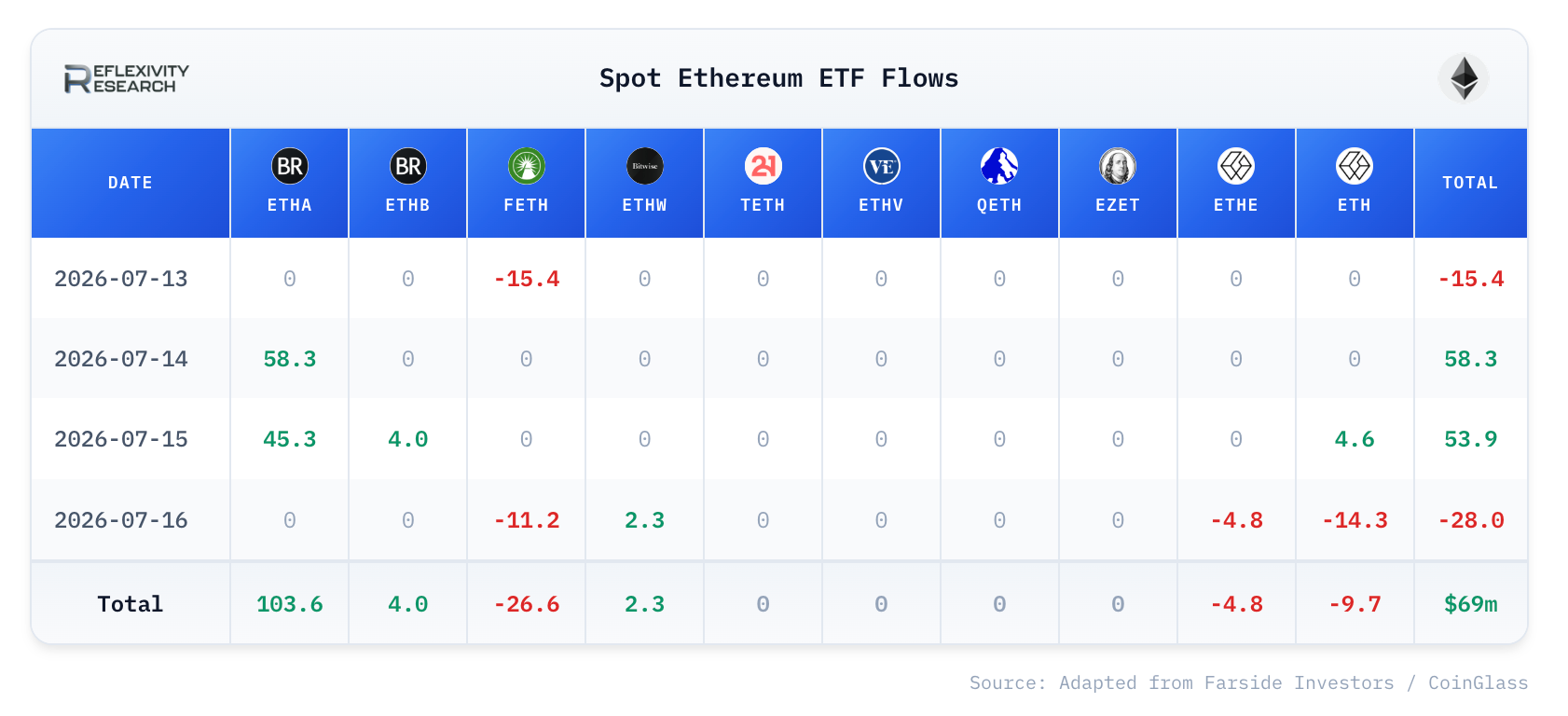
US spot Ethereum ETFs took in a net +$68.8M across the four sessions of July 13 to 16, and the notable feature is the contrast with bitcoin. While the BTC complex netted -$56.8M, ether funds drew money back, so this week's clearer relative-strength signal sat in flows rather than price. Both assets actually rose: ether gained about 11% over the seven sessions against bitcoin's roughly 4%, per CoinDesk. The flows tracked the same macro spine as the bitcoin book. Ether funds shed just -$15.4M on Monday July 13 as the Iran-driven risk-off hit, then posted their biggest day of the week, +$58.3M, on Tuesday July 14, the session of the cooler-than-expected CPI print, followed by +$53.9M on Wednesday before a -$28.0M give-back on Thursday. Ether itself bottomed near $1,781 on Monday and firmed toward $1,920 by Thursday.
BlackRock's ETHA took +$103.6M, more than the entire complex's net, and was the only fund adding money on the two big days, +$58.3M Tuesday and +$45.3M of Wednesday's total. Fidelity's FETH carried that week and was the sole meaningful detractor this one, at -$26.6M, on ordinary redemptions rather than any named event, while the Grayscale mini trust, ticker ETH, gave back -$9.7M.
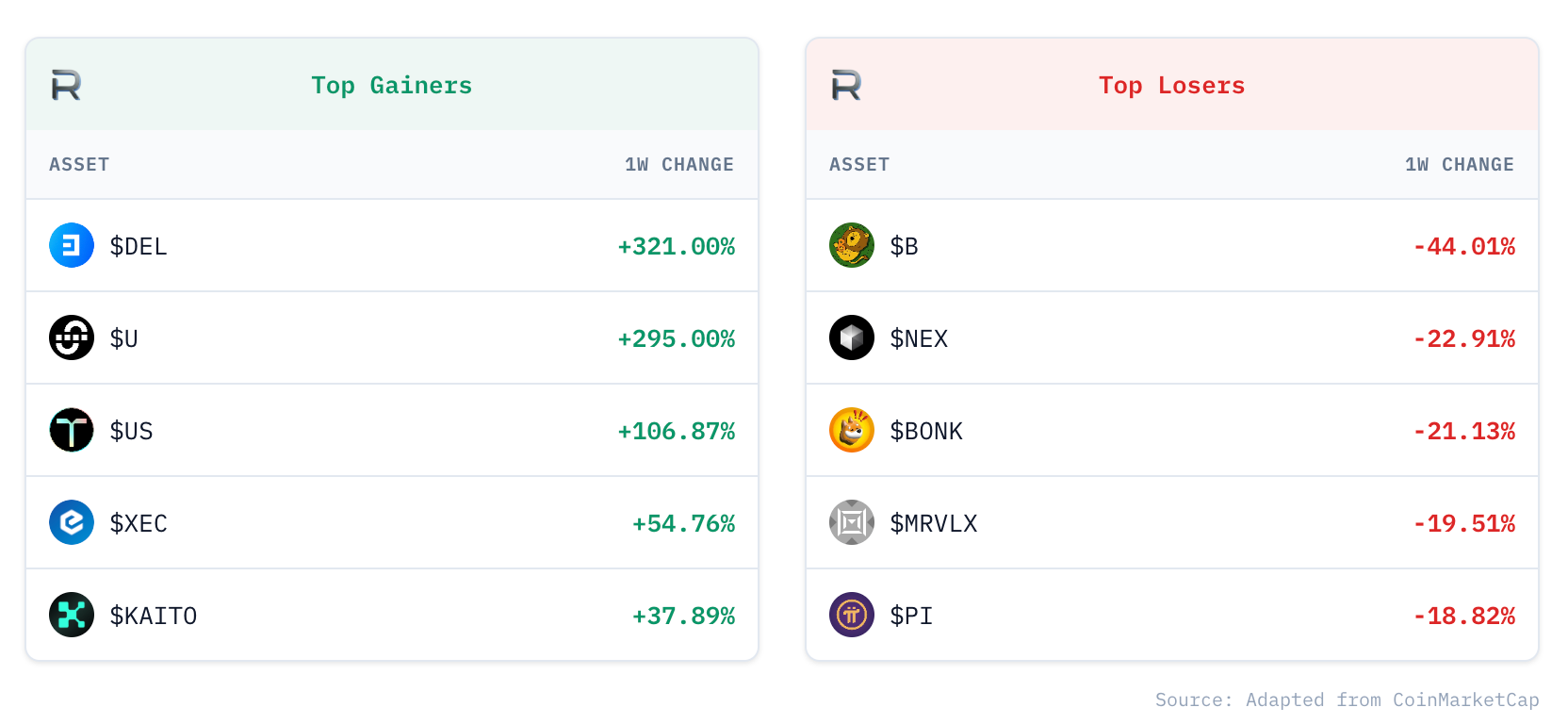
Top Gainers & Losers
Disclaimer: This research report is exactly that — a research report. It is not intended to serve as financial advice, nor should you blindly assume that any of the information is accurate without confirming through your own research. Bitcoin, cryptocurrencies, and other digital assets are incredibly risky, and nothing in this report should be considered an endorsement to buy or sell any asset. Never invest more than you are willing to lose, and understand the risk that you are taking. Do your own research. All information in this report is for educational purposes only and should not be the basis for any investment decisions that you make.