
Tokenized Deposits on ZKsync
Weekly Market Update #115


This week’s edition is brought to you by TenX Protocols Inc., a multi-asset digital treasury for Solana, Sui, and Sei, where Networks Become Revenue.

Before jumping into last week’s action, check out our latest research pieces below:
Weekly Market Developments
ZetaChain halts cross-chain transactions after smart contract attack - link
DeFi United coalition unveils detailed plan to restore rsETH after $292M Kelp DAO exploit - link
Circle Ventures discloses purchases of AAVE - link
Polymarket seeks CFTC blessing to bring main exchange back to the US - link
Lido Finance shares update on its exposure to the Kelp DAO rsETH incident - link
Strategy acquires 3,273 BTC for $255M, treasury now holds 818,334 BTC - link
Memecoin project rug pulled for $1.5M - link
Volo, a Sui-based liquid staking protocol, exploited for $3.5M - link
Tether launches MDK, an open infrastructure layer for Bitcoin mining - link
AngelList announces USVC, a tokenized venture capital product - link
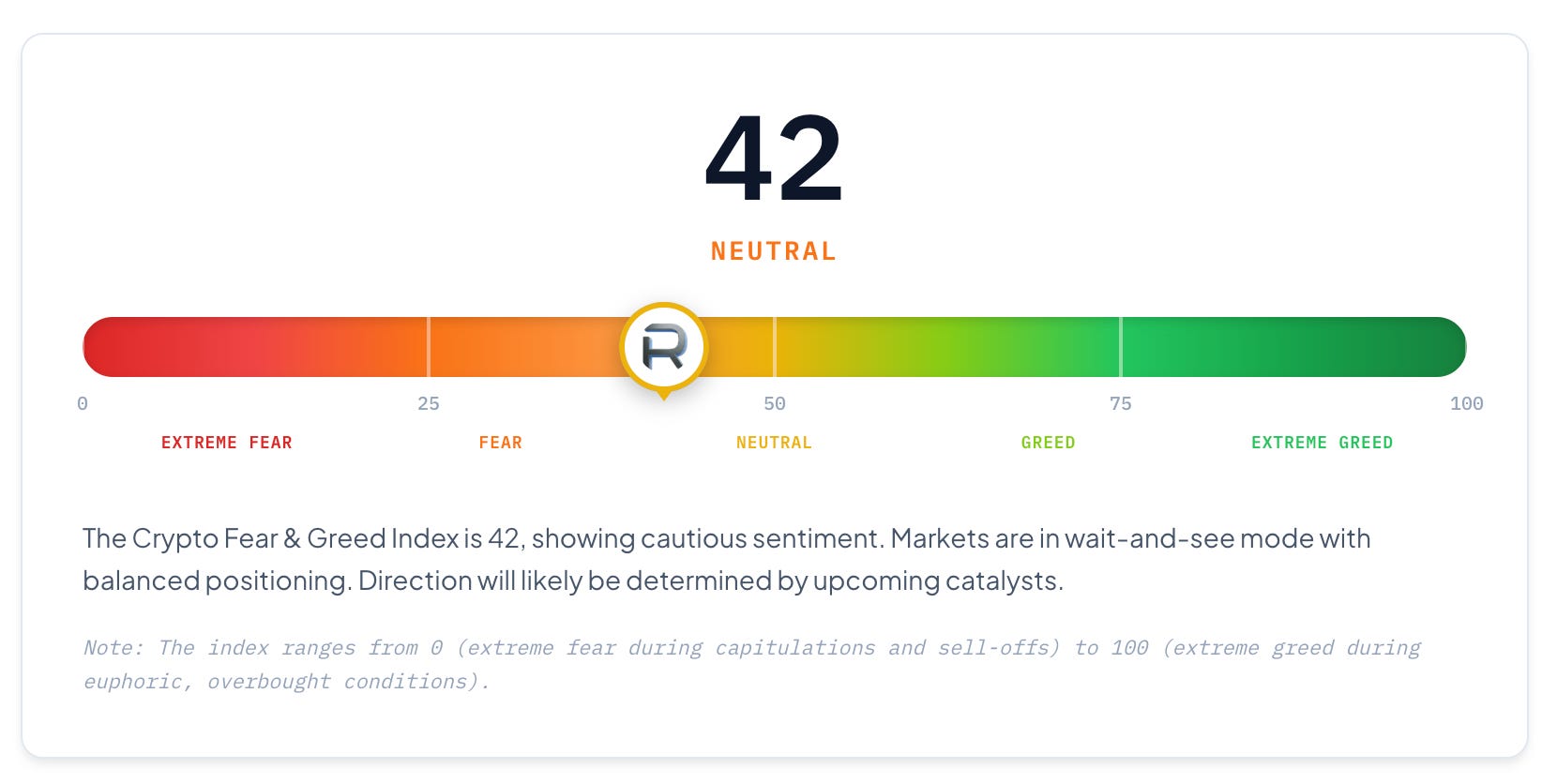
Fear & Greed Index
ETF Flows
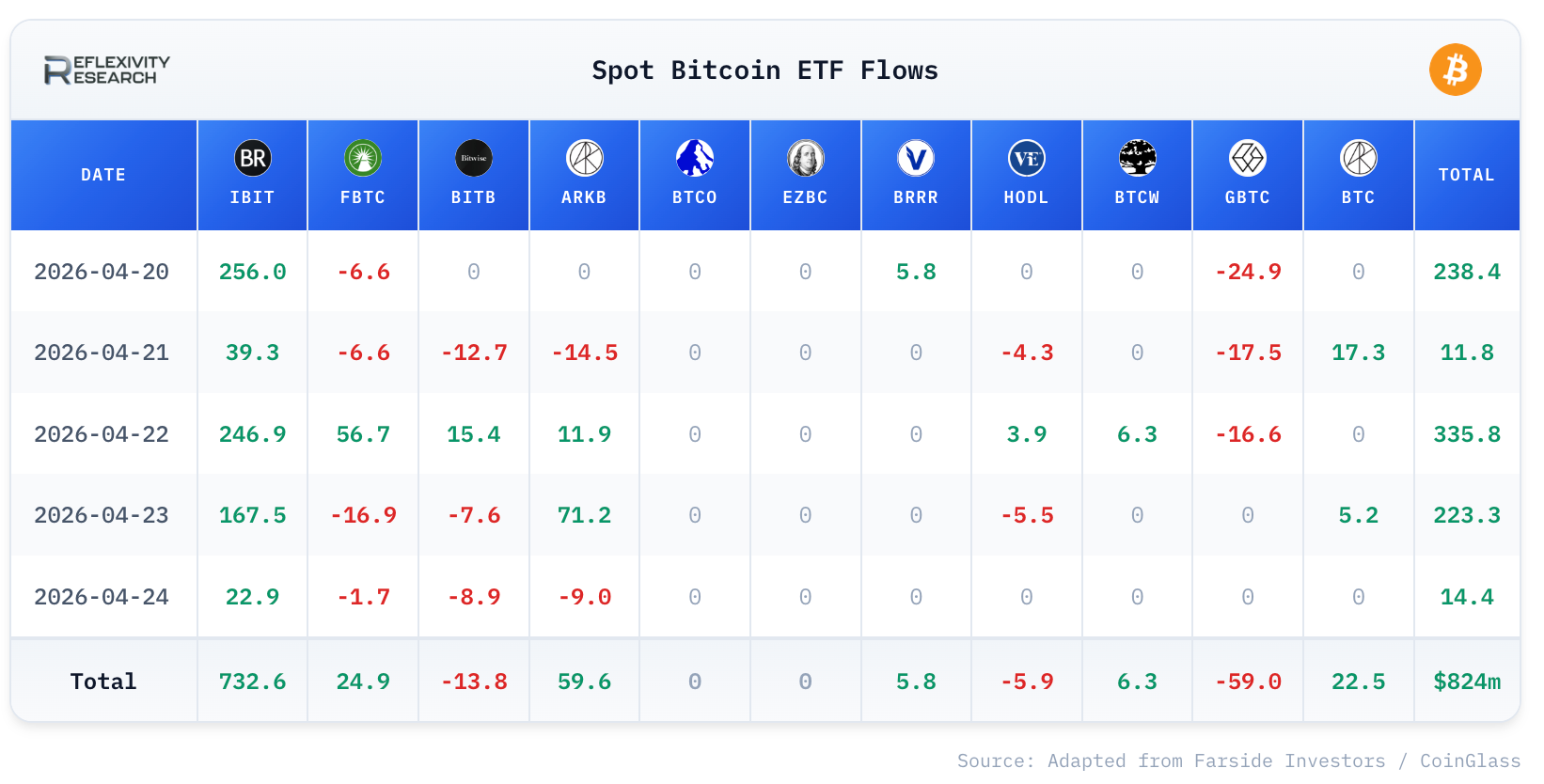
BTC flows saw net +$824M for the week across 5 inflow days and 0 outflow days.
BlackRock’s IBIT dominated with +$733M (89% of total inflows). ARK’s ARKB followed with +$60M, maintaining its position as the consistent second-place fund.
GBTC saw the largest outflows at -$59M.
The best day was Wednesday with +$336M across all funds.
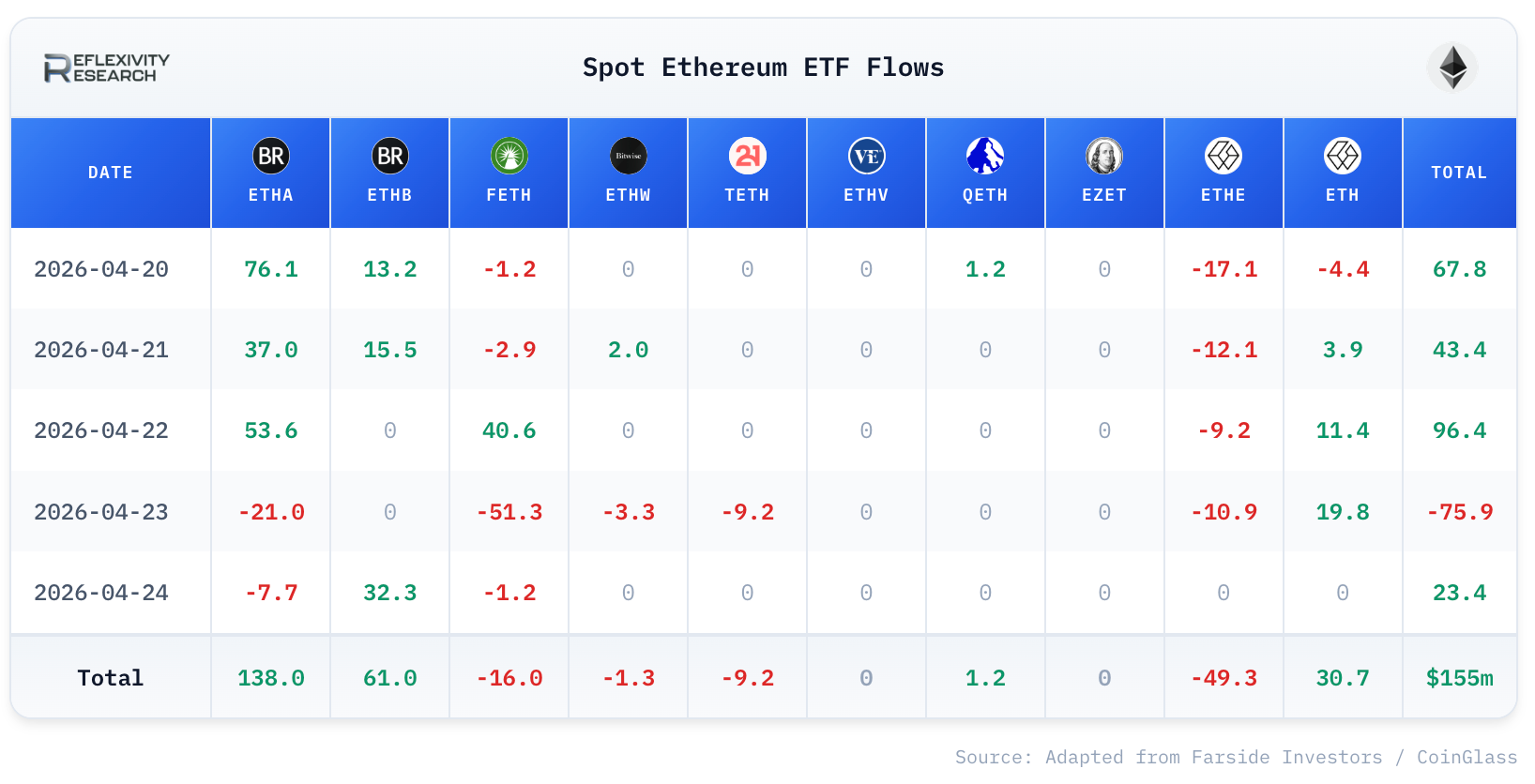
Net +$155M for the week across 4 inflow days and 1 outflow day.
BlackRock’s ETHA led with +$138M (89% of total). ETHB followed with +$61M.
The best day was also Wednesday with +$96M.
ETH flows at 19% of BTC activity, showing gradual but modest institutional interest in Ethereum products.
Spotlight: Tokenized Deposits on ZKsync
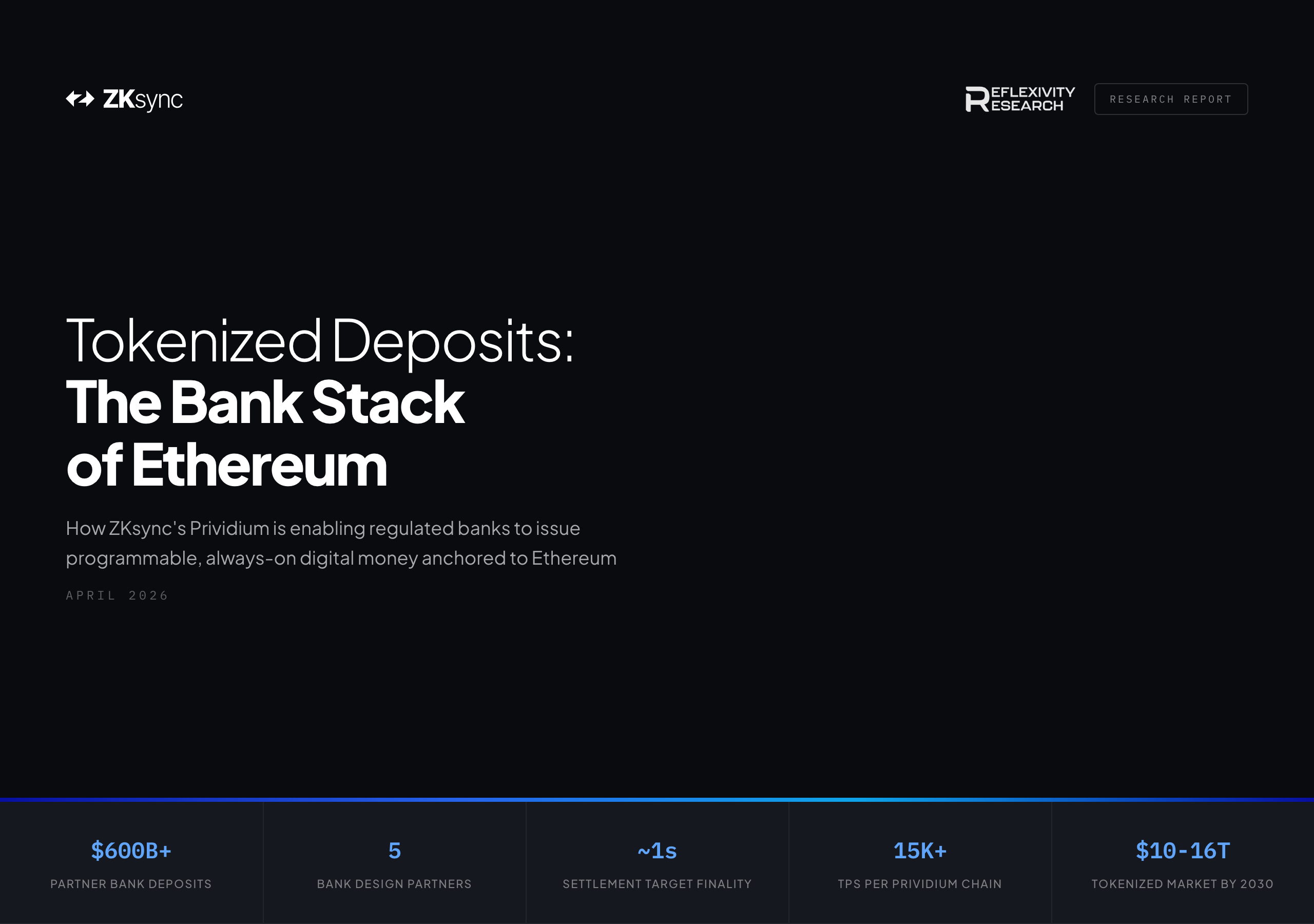
In March 2026, the Cari Network, founded by Eugene Ludwig, the 27th US Comptroller of the Currency, announced that five US regional banks (Huntington, M&T, KeyCorp, First Horizon, Old National) with $600B+ in combined deposits and ~$779B in total assets are building a tokenized deposit network on ZKsync’s Prividium, with the Mid-Size Bank Coalition of America’s endorsement. Days later, ZKsync partnered with BitGo, a federally chartered digital-asset bank with full, unconditional OCC approval, to bring institutional custody and wallets to the same Prividium-based “Bank Stack”: a three-plane architecture spanning Ethereum settlement, private execution, and institutional services (BitGo, Fireblocks, Phylax, Okta SSO).
Prividium uses zero-knowledge proofs to keep transaction data private while anchoring every batch to Ethereum, sustaining up to 15,000 TPS, ~1-second Settlement Target Finality, and proving costs under $0.0001 per transaction; 35+ financial institutions have already validated the architecture in live cross-border-payment and intraday-repo demos. Cari targets a Q3 2026 pilot and Q4 2026 customer availability, set against $5.7T in 2024 adjusted stablecoin volume, a U.S. Treasury projection of up to $6.6T in potential deposit outflows, and $10-16T of tokenized assets forecast by 2030. Our brief walks the Bank Stack architecture, the control-vs-connectivity dilemma that ZK proofs resolve, Prividium’s design, the five partner banks and deployment timeline, the BitGo / Fireblocks / Phylax integrations, three institutional use cases (cross-border payments, intraday repo, corporate treasury), the regulatory landscape, and the path to production by year-end.
Check out the full report here.
Top Gainers & Losers
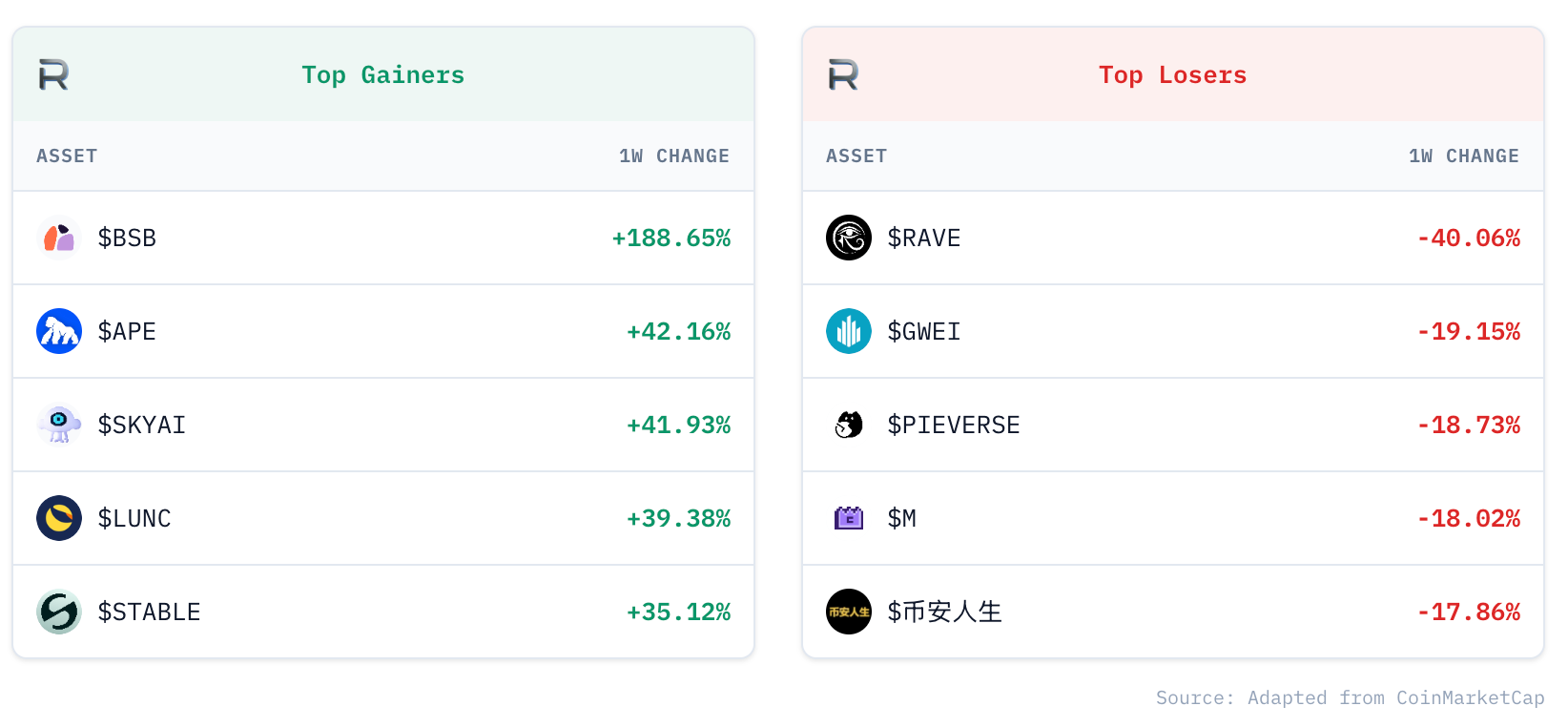
The top gainer this week was: Block Street ($BSB), +188.65%. Block Street, a self-described unified liquidity layer for tokenized capital markets, climbed more than 70% intraday on April 24 to an all-time high near $0.59 and extended gains on April 25 when staking went live. The new module uses a time-weighted lock: rewards and governance multipliers scale up to 4x linearly with lock duration to a maximum of 365 days, designed to pull supply out of circulation and concentrate voting power with long-term holders. Independent commentary urges caution, however the daily turnover hit 31-46% of market cap, the rally was near-uniform across all 58 trading pairs, and no whitepaper or top-tier spot listing accompanied the move.
The top loser was: RaveDAO ($RAVE), -40.06%. RAVE's seven-day decline is the continuation of a much larger collapse that began April 18-19, when the token cratered from an all-time high of $27.88 to roughly $1.24, a ~95% drawdown that erased close to $6B in market cap. Binance and Bitget have both opened formal investigations into the trading activity, with on-chain investigator ZachXBT alleging that nine wallets controlled ~95% of supply and that 18.58M tokens were moved to Bitget shortly before a 10,800% rally that liquidated about $44M of shorts. RaveDAO has denied involvement and dismissed the allegations as "rumors," but with exchange probes still active and supply-concentration concerns unresolved, the token has continued to drift lower through the report window.
Disclaimer: This research report is exactly that — a research report. It is not intended to serve as financial advice, nor should you blindly assume that any of the information is accurate without confirming through your own research. Bitcoin, cryptocurrencies, and other digital assets are incredibly risky, and nothing in this report should be considered an endorsement to buy or sell any asset. Never invest more than you are willing to lose, and understand the risk that you are taking. Do your own research. All information in this report is for educational purposes only and should not be the basis for any investment decisions that you make.
Excellent report, indeed.