
Lighter announces native token burn
Weekly Market Update #118


This week’s edition is brought to you by TenX Protocols Inc., a multi-asset digital treasury for Solana, Sui, and Sei, where Networks Become Revenue.

Before jumping into last week’s action, check out the following pieces:
The DEFT Valour Investment Opportunity Index (DVIO), engineered by DeFi Technologies, tracks the top 50 crypto assets by AUM across Valour’s 100+ exchange-listed ETPs. Every constituent represents real, regulated investor capital, with weights rebalanced weekly to reflect shifts in capital allocation and net flows. Proprietary research on the index is published weekly here.
Weekly Market Developments
Edel Finance pauses its lending protocol after a tokenized Google stock exploit leaves about $403K in bad debt - link
Venice AI raises a $65M Series A at a $1B valuation, led by Dragonfly - link
Open Standard unveils Open USD, a stablecoin backed by more than 140 firms including Visa, Mastercard, Stripe and Coinbase - link
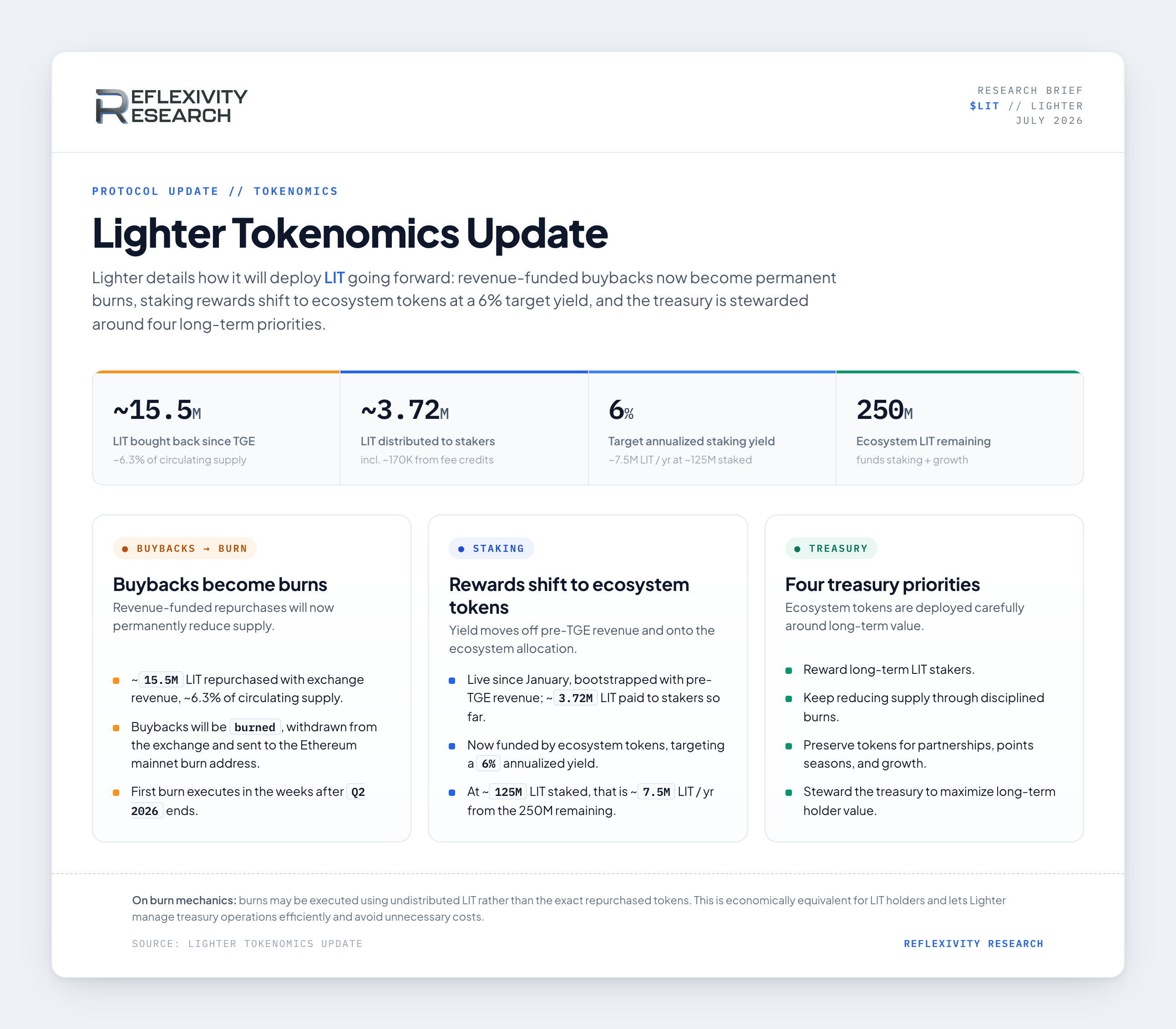
Lighter to permanently burn repurchased LIT and fund staking from a 250M LIT ecosystem reserve at a 6% target yield - link
Tread Foundation announces the TREAD token for its tread.fi trading platform - link
Drift Protocol rebrands to Velocity DEX ahead of a perpetuals-only relaunch - link
dYdX Labs launches Arcus, a new perps and tokenized-stock DEX built with Robinhood on Robinhood Chain - link
Standard Chartered becomes the first G-SIB to offer clients integrated USDC minting and redemption, via Circle - link
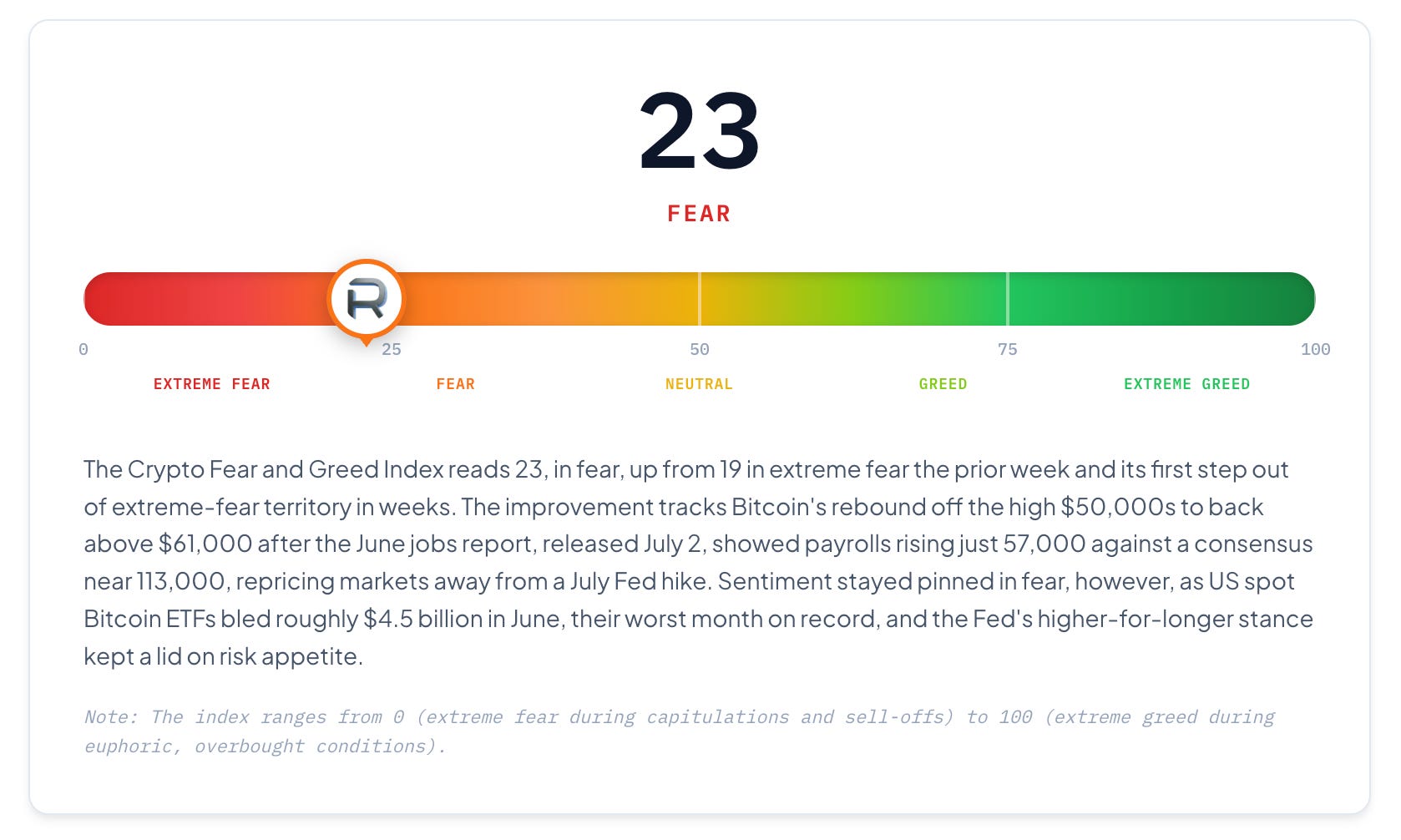
Fear & Greed Index
ETF Flows
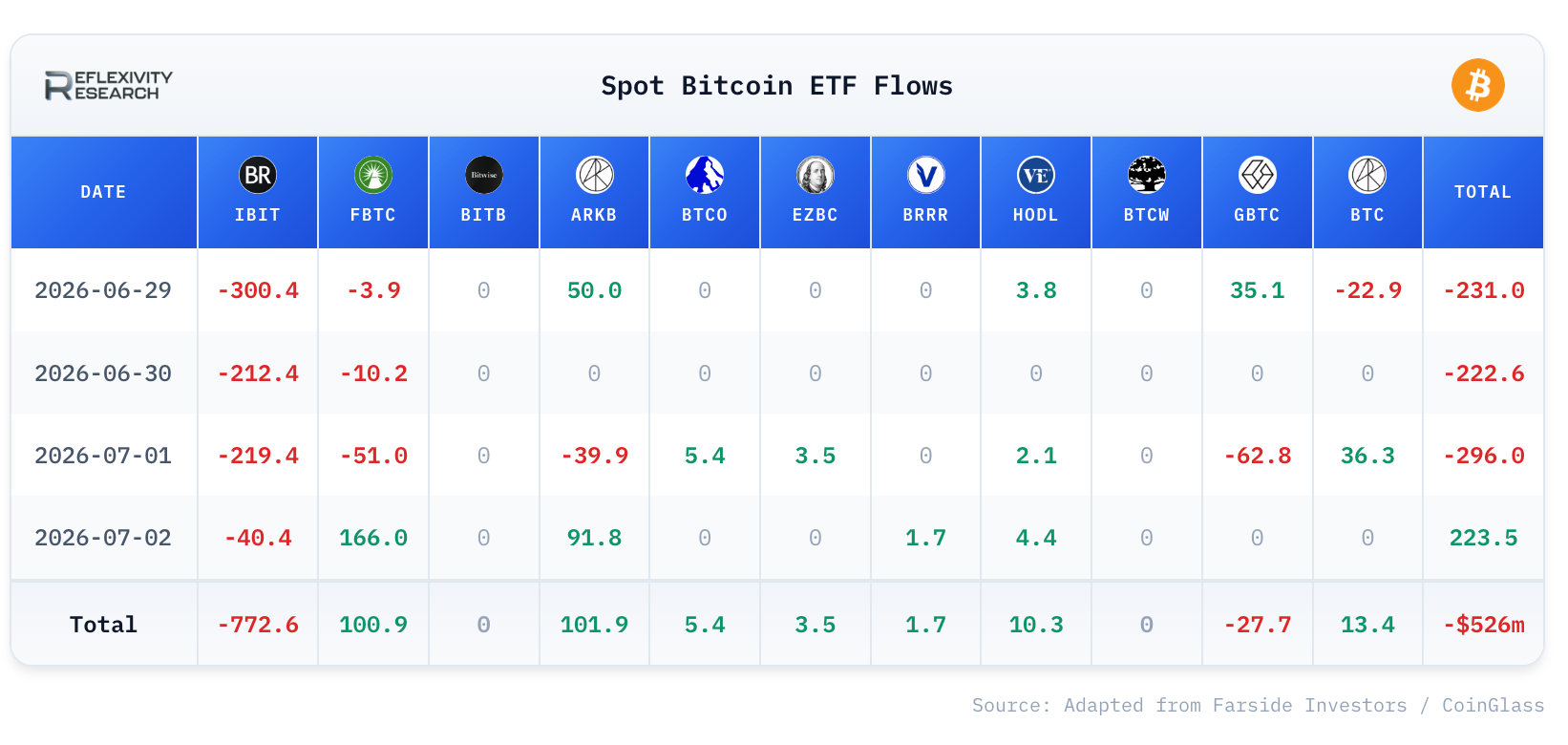
US spot Bitcoin ETFs shed a net -$526.1M across the four sessions from June 29 to July 2, capping the worst month on record for the product, which bled roughly $4.5B in June with about $3.55B of that from BlackRock’s IBIT.
The window was again almost entirely an IBIT story: the fund shed -$772.6M over the four days, front-loading its exodus with -$300.4M on June 29, -$212.4M on June 30 and -$219.4M on July 1, more than accounting for the group’s entire net loss. The bleed tracked a grinding price decline, with Bitcoin sliding from roughly $59,860 on the morning of June 29 to about $58,500 at the June 30 quarter-end and a window low near $58,280 on July 1. Reporting tied the IBIT redemptions to quarter-end and month-end portfolio rebalancing against rising Treasury yields rather than a structural exit.
The tape turned decisively on July 2, when the June non-farm payrolls report showed the economy added just 57,000 jobs against a consensus near 113,000, with the unemployment rate ticking down to 4.2%. The soft print undercut the higher-for-longer regime that Kevin Warsh’s hawkish June FOMC had set, reviving easing expectations and lifting Bitcoin roughly 2% to 3% back above $61,000. Flows reversed in lockstep: the complex took in a net +$223.5M on July 2, its strongest day in roughly two months and the end of a multi-session outflow streak, led by Fidelity’s FBTC at +$166.0M and ARK 21Shares’ ARKB at +$91.8M, with VanEck’s HODL adding +$4.4M and CoinShares Valkyrie’s BRRR +$1.7M. Notably, IBIT sat out the rebound, still logging a -$40.4M outflow on the day, leaving the July 2 turn driven entirely by funds other than BlackRock’s, even as June’s redemptions pushed year-to-date flows into the red.
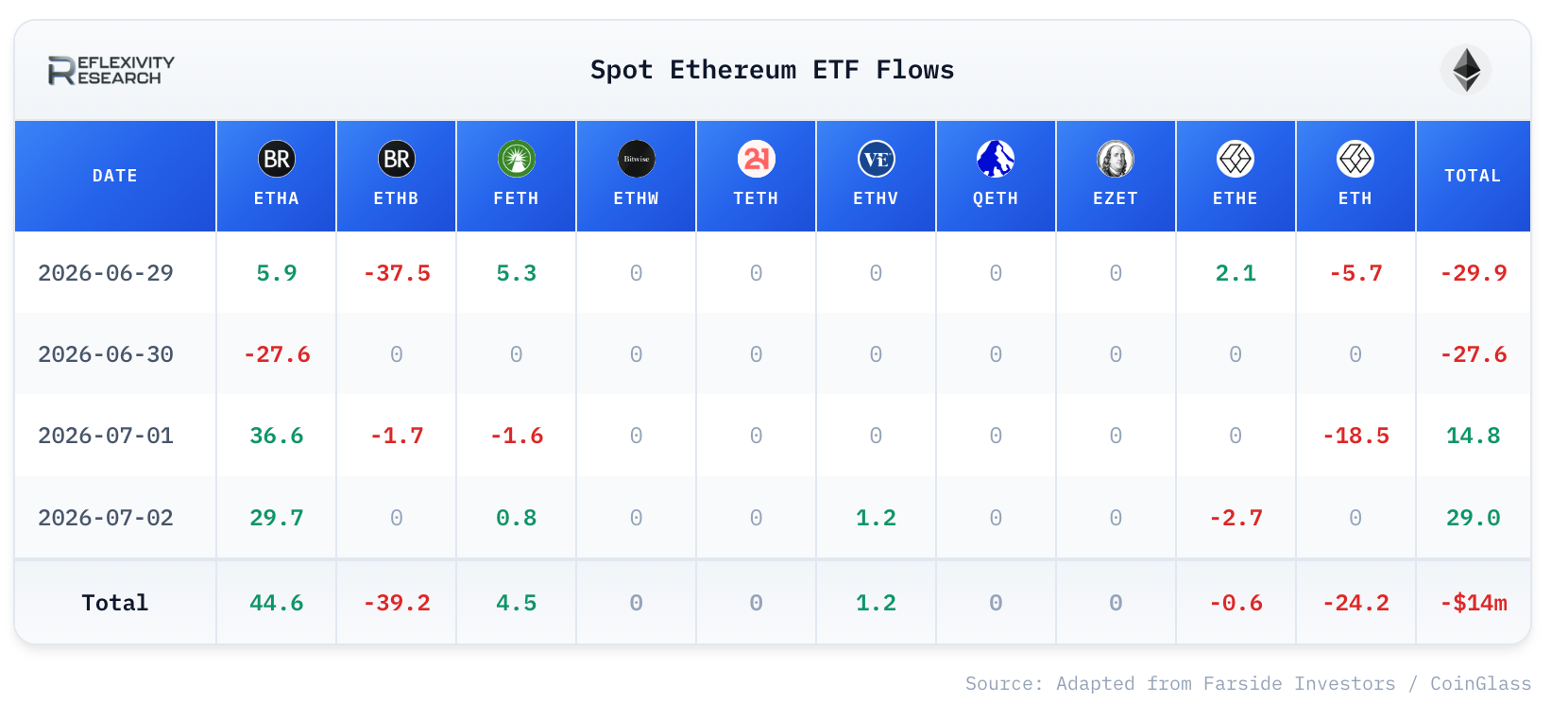
US spot Ethereum ETFs closed the four sessions from June 29 to July 2 essentially flat, shedding a net -$13.7M even as the group flipped from redemptions to creations alongside a sharp recovery in the underlying price.
The week opened soft, with the funds bleeding -$29.9M on June 29 and a further -$27.6M on June 30 as ETH slid toward the high $1,500s, then turned on July 1, drawing +$14.8M, before accelerating on July 2 to +$29.0M of net inflows as ETH jumped roughly 9% to about $1,708. That final-day surge tracked a broad risk rally after the same weak June jobs print cooled the higher-for-longer narrative and lifted rate-sensitive assets across the board.
Fund-level attribution exposes a split inside BlackRock's own lineup: the non-staked iShares Ethereum Trust (ETHA) led all issuers with +$44.6M of net inflows, concentrated in the two recovery sessions (+$36.6M on July 1 and +$29.7M on July 2) after an isolated -$27.6M redemption on June 30, while BlackRock's iShares Staked Ethereum Trust (ETHB), the staking-enabled product that launched in March 2026, posted the window's largest single outflow at -$37.5M on June 29 and a -$39.2M net decline for the week. Grayscale's Ethereum Mini Trust lost -$24.2M and its legacy Ethereum Trust (ETHE) slipped -$0.6M, while Fidelity's FETH (+$4.5M) and VanEck's ETHV (+$1.2M) offered only modest support. The net result was a standoff: BlackRock's flagship absorbed fresh money while its staked sibling and Grayscale's vehicles handed it back, leaving the asset class close to unchanged despite ETH's double-digit two-day bounce.
Spotlight
Top Gainers & Losers
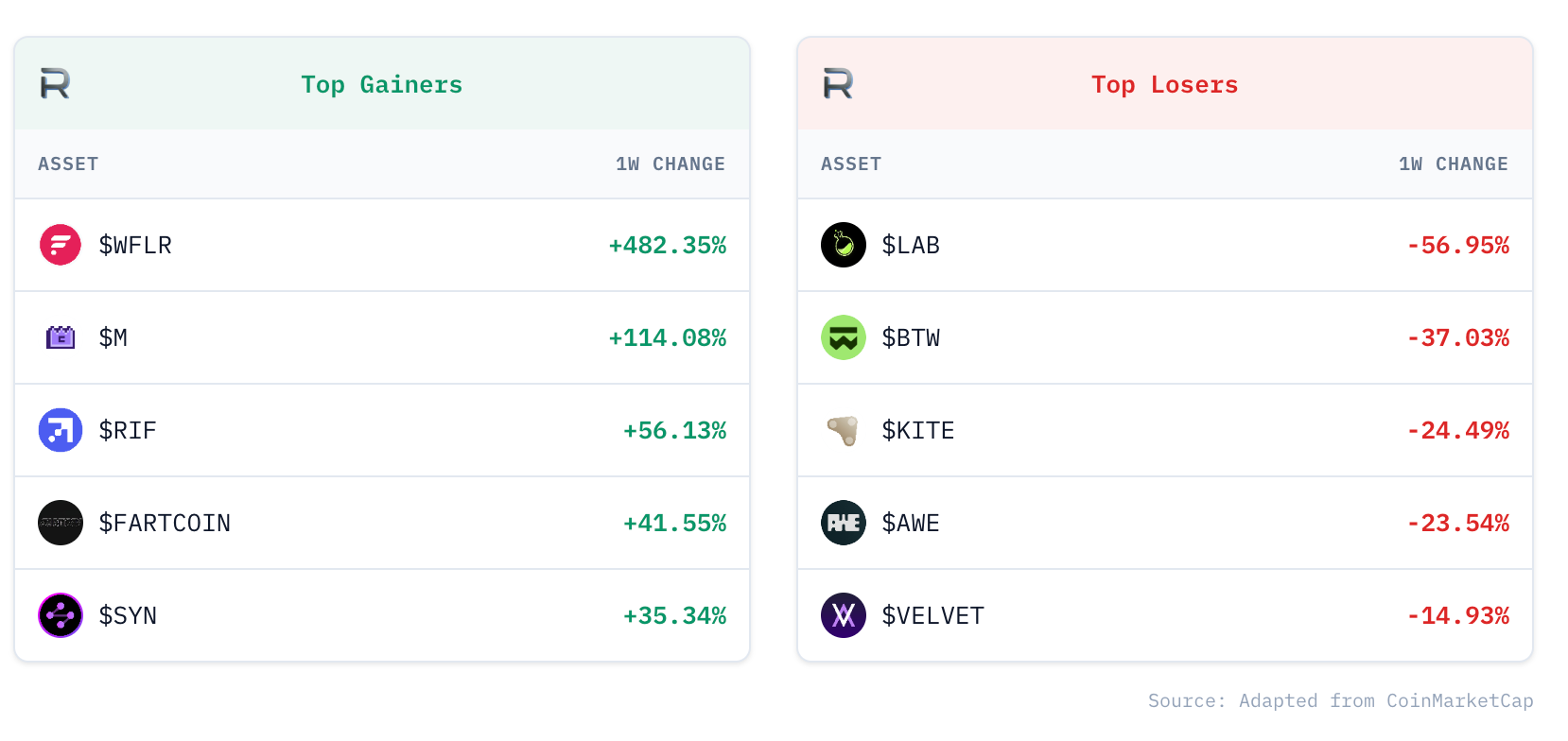
$M (+114.08%), the token of the MemeCore layer-1 meme blockchain at roughly a $2.3B market cap, had no discrete catalyst: it is a low-float rebound off a punishing selloff, having shed more than 80% from an April high near $4.84 before snapping back and running from about $1.10 to $1.73 in a single session on July 2 as broad crypto sentiment improved. $RIF (+56.13%), the token of the Bitcoin sidechain Rootstock, likewise advanced with no dated catalyst; Rootstock's channels published only routine node-patch work in the window, and the move reads as a thin, low-float bounce and small-cap rotation.
Only $SYN (+35.34%) had a genuine dated catalyst. On June 29, BitMEX co-founder and Maelstrom CIO Arthur Hayes disclosed on X that he had bought 6.16 million SYN, about $2.2 million, and endorsed Hypercall, an on-chain options exchange built by the Synapse team and settled on Hyperliquid, framing it as a challenger to Deribit; Arkham on-chain data corroborated the buy and SYN spiked as much as 40% intraday. The move is narrative and positioning driven rather than fundamentals led, with protocol revenue and roughly $11 million in TVL flat as the token's market cap pushed past $110 million.
$LAB (-56.95%) run simply unwound: nothing fundamentally changed, with ZachXBT's mid-May investigation still framing the token as insider-controlled, an alleged 95% or more of supply against roughly $8.5 million of tradeable liquidity, and the pump mean-reverted. The decline was accelerated by a leveraged flush, with LAB falling about 34% in a day toward $9 on July 1 as open interest dropped 23% to about $130 million, and by an unlock overhang, with a 282 million LAB unlock, about 28% of supply, scheduled for August 14 keeping sellers in control. $VELVET (-14.93%) extended its slide from issue #120, when it fell 70.58%, and the net figure masks a violent round trip: the token printed an all-time high near $2.08 on June 29 on the migration of its liquidity to Aerodrome and the synthetic, leveraged pre-IPO markets it runs, most prominently for SpaceX, then reversed roughly 80% to about $0.43, a sell-the-news unwind aggravated by on-chain evidence of insider and market-maker distribution during the run-up and a looming July 10 vesting unlock.
The remaining losers were momentum and supply-driven with no discrete in-window catalyst. $BTW (-37.03%), Bitway, extended a post-parabolic unwind from its June 20 all-time high near $0.19, a low-float, high-FDV mean-reversion after June perpetual-futures listings drew in speculative flows. $KITE (-24.49%), the token of AI-payments layer-1 Kite AI, continued a post-launch downtrend, down about 66% from its March all-time high, pressured by recurring monthly ecosystem unlocks of roughly 62.5 million tokens and a fully diluted valuation near $1.1 billion against a small circulating float. $AWE (-23.54%), AWE Network, formerly STP Network, fell on sector-wide AI-token weakness and a technical breakdown rather than any news, with the token already fully circulating.
Disclaimer: This research report is exactly that — a research report. It is not intended to serve as financial advice, nor should you blindly assume that any of the information is accurate without confirming through your own research. Bitcoin, cryptocurrencies, and other digital assets are incredibly risky, and nothing in this report should be considered an endorsement to buy or sell any asset. Never invest more than you are willing to lose, and understand the risk that you are taking. Do your own research. All information in this report is for educational purposes only and should not be the basis for any investment decisions that you make.